

Is Your U.S. Subsidiary a Foreign Importer of Record (IOR)?
A two-part guide to determining importer status under CBP’s new rule and comparing options for continuing to import.Authors
Overview
This guide covers Executive Order 14411, Strengthening Customs Enforcement (June 3, 2026), and U.S. Customs and Border Protection’s (CBP) interim final rule, Heightened Requirements for Foreign Importers of Record. The rule (CBP Dec. 26-19, 91 Fed. Reg. 69977, Nov. 6, 2026) amends 19 C.F.R. Parts 110, 111, 141, 142, and 171.
|
EFFECTIVE FOR IORs January 5, 2027 |
COMMENTS DUE January 5, 2027 |
BROKER COMPLIANCE (IF DELAY REQUESTED) No later than May 6, 2027 |
CTPAT-VALIDATED BROKERS ~643 of ~3,100 (≈21%) |
Introduction: What EO 14411 and the New IOR Rule Mean for Foreign-Owned Companies in the U.S.
On June 3, 2026, President Trump signed Executive Order 14411, Strengthening Customs Enforcement (91 Fed. Reg. 35125). The Executive Order directs the Department of Homeland Security and U.S. Customs and Border Protection (CBP) to restrict who may act as an importer of record (IOR) in the U.S. It draws a formal line between “U.S.” and “foreign” IORs and requires foreign IORs to be validated under the Customs Trade Partnership Against Terrorism (CTPAT) or to file through a CTPAT-validated customs broker. It also calls for higher bonds and asset requirements, broader supply-chain disclosures, and stiffer penalties.
The Department of Homeland Security (DHS) and CBP implemented the EO’s IOR provisions in an Interim Final Rule, Heightened Requirements for Foreign Importers of Record. CBP Dec. 26-19, 91 Fed. Reg. 69977 (Nov. 6, 2026). The rule, which takes effect January 5, 2027, makes two important changes:
- It defines a “U.S. importer of record” more narrowly than before. Every importer that does not meet the definition is treated as a foreign IOR.
- It limits how foreign IORs may make entry of goods into the U.S. A foreign IOR must be CTPAT-validated itself or use a CTPAT-validated licensed customs broker, for both formal and informal entries.
Why this matters to foreign-owned U.S. subsidiaries
Being incorporated and operating in the United States is no longer enough to be a U.S. importer. Besides being organized under U.S. law and “located” in the U.S., an IOR must meet one of two tests, at all times:
- Ownership test: at least 51% of its beneficial owners, as defined in new 19 C.F.R. 110.1, are U.S. citizens or lawful permanent residents; or
- Real-property test: it directly owns a “significant amount of unencumbered” U.S. real property.
A subsidiary whose ultimate owners are outside the United States will generally fail the ownership test, so it must rely on the real-property test. A subsidiary that leases its plant or warehouse, holds its real estate through an affiliate, or has mortgaged its real property may not qualify as a U.S. IOR, even if it has U.S. employees, payroll and a long import history in the U.S.
CBP FAQs: How much “unencumbered” real property is enough?
The rule leaves “significant” undefined, but CBP has since addressed the question in FAQs on its Strengthening Customs Enforcement page:
- Threshold. A “significant amount of unencumbered real property” is equivalent to 100% of the IOR’s prior-year entered value or $20 million, whichever is greater (i.e., the IOR must have unencumbered real property above that minimum threshold). CBP says the purpose is to ensure enough U.S. assets exist to cover duties, taxes, and fees.
- “Unencumbered” means net value. The property may carry some encumbrance, such as a mortgage, but only its net unencumbered value counts toward the threshold. This additional requirement would challenge even the most liquid real estate investors.
- The ownership test is an alternative. An entity that meets the 51% U.S. ownership-and-control test does not need to meet the property threshold.
Example: A subsidiary that entered $60 million of goods last year needs at least $60 million of net equity in U.S. real property that it owns directly. A $90 million plant with a $45 million mortgage counts for only $45 million, so the subsidiary falls short. A subsidiary with $8 million of entered value still needs $20 million.
The FAQs are agency guidance, not regulatory text. They do not say how property is to be valued (book or appraised value) or how an importer with no prior-year entries is measured. Time will tell whether this agency guidance sticks and whether courts challenge it.
From January 5, 2027, a foreign-IOR subsidiary that is not itself CTPAT-validated can import only through a CTPAT-validated broker, and only about one in five licensed brokers is CTPAT-validated. A subsidiary can avoid that dependence by obtaining its own CTPAT validation. CTPAT’s importer eligibility rules are broader than the new U.S.-IOR test (see Part B). Every broker must verify each client’s status before filing, and a broker that is not validated must stop filing for foreign-IOR clients. Each entry will carry a declaration of U.S.-IOR status, and an inaccurate declaration exposes the importer to enforcement action and delayed release of goods.
The rule also reaches transactions in which a non-U.S. parent or affiliate sells to the U.S. subsidiary or its customers on delivered-duty-paid (DDP) terms and acts as IOR itself. Further EO 14411 measures are still to come, including minimum bond and asset requirements and expanded supply-chain disclosures.
How to use this guide
Part A determines whether your company is a U.S. or foreign IOR. Part B sets out the pathways available to a foreign IOR. The decision matrix compares the options side by side.
Part 1 — Status Determination: U.S. IOR or Foreign IOR? (19 C.F.R. 110.2–110.3)
Any importer that does not satisfy the U.S. IOR definition is, by default, a foreign IOR. For entities, every prong must be met at all times, not just on the date of entry.
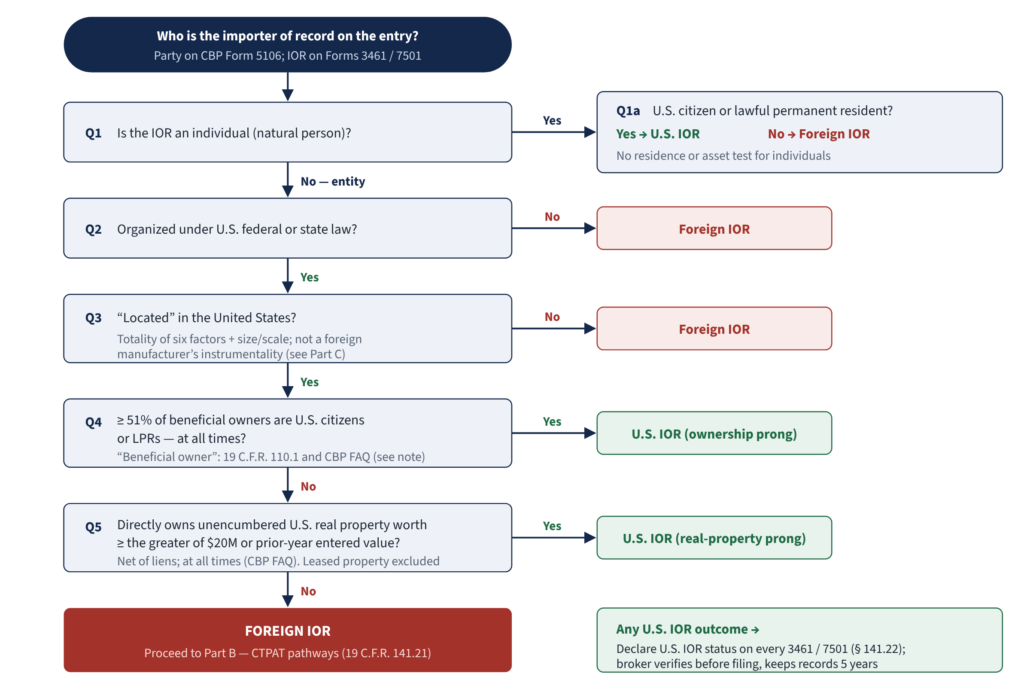
Figure 1. An individual qualifies with citizenship/Lawful permanent resident (LPR) status alone. An entity must clear Q2 and Q3 and then either Q4 or Q5. Failing any entity prong — or failing Q4 and Q5 together — makes the importer a foreign IOR.
Note to Q4 — Who is a “beneficial owner”?
- New 19 C.F.R. 110.1. A beneficial owner is a natural person who, directly or indirectly, either (a) exercises substantial control over the entity, or (b) owns or controls at least 25% of its ownership interests. A person can qualify either way, or both.
- Look-through. The definition reaches through every layer of holding companies to the individuals at the top. For a foreign-owned subsidiary, the beneficial owners are the parent group’s ultimate individual owners, not the parent company. Every entity has at least one beneficial owner, and there is no maximum.
- Substantial control. Senior officers (such as the president or CEO), persons who can appoint or remove officers or directors, and important decision-makers all exercise substantial control. CBP modeled the definition on FinCEN’s Corporate Transparency Act rule (31 C.F.R. 1010.380(d)) but says it is not bound by FinCEN’s interpretations.
- CBP FAQ. CBP’s FAQs confirm that an entity can qualify as a U.S. IOR even if none of its beneficial owners are U.S. citizens or LPRs, but only through the real-property test (Q5). An entity that meets the 51% test does not need to meet the real-property threshold.
Note: Section 110.2(a) also requires that the qualifying U.S. beneficial owners “have control of the entity.” The rule does not say whether the 51% is counted by number of beneficial owners or by ownership interest. Under a headcount reading, a foreign-owned subsidiary with several U.S.-citizen senior officers might qualify, but companies should not rely on that reading without CBP guidance.
Practice point — foreign-owned U.S. subsidiaries
A Delaware or Michigan subsidiary of a Chinese, Taiwanese, Korean, Japanese or German parent will usually fail Q4, because its beneficial owners are foreign. It is a U.S. IOR only if it independently clears Q5: it must directly own unencumbered U.S. real property in a “significant” amount, continuously. A leased plant or a plant held by a sister company appears not to qualify. A mortgaged facility counts only for its net equity, and under CBP’s FAQs that net value must reach the greater of $20 million or 100% of the prior year’s entered value.
Part 2 — Foreign IOR: Pathways to Keep Importing (19 C.F.R. 141.21)
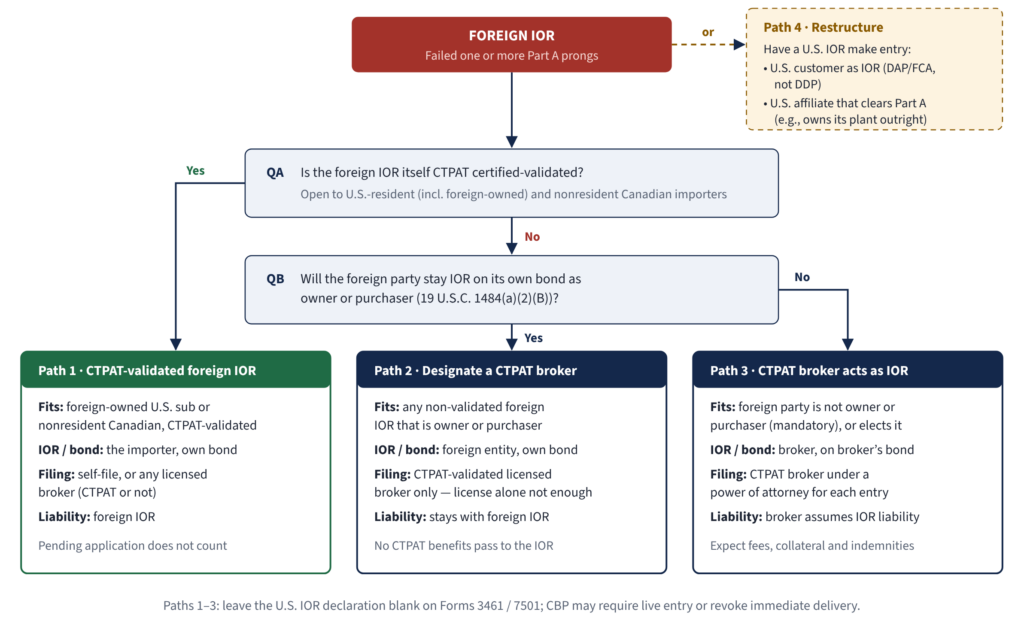
Beginning January 5, 2027, a foreign IOR may not enter merchandise for consumption (formal or informal) unless it travels one of the CTPAT pathways below, or restructures so that a U.S. IOR makes the entry.
CTPAT eligibility is not the same as the new U.S.-IOR test
CTPAT applies its own importer eligibility criteria, not 19 C.F.R. 110.2. Under CBP’s CTPAT importer requirements, an applicant must be an active U.S. importer (one that has imported within the past 12 months) or a nonresident Canadian importer, with a staffed business office in the United States or Canada.
A foreign-owned U.S. subsidiary with U.S. operations therefore appears eligible to apply for CTPAT and pursue validation in its own right, even though it is a “foreign IOR” under the new rule. CBP’s statement that “only Canadian foreign IORs are eligible for CTPAT validation” is best read as referring to nonresident importers, meaning offshore sellers acting as IOR.
Note: Only validated status qualifies. Certification alone is not enough, and according to CBP’s FAQ a pending application does not satisfy the requirement. CBP has not expressly addressed this point, so companies should confirm their eligibility with CTPAT and plan for Path 2 in the meantime.
For more information
For help determining your company’s importer-of-record status, preparing for the January 5, 2027 effective date, or submitting comments on the interim final rule, please contact Mark Heusel (mheusel@dwlaw.com) or your Dickinson Wright Trade & Customs Team attorney.
Sources: Executive Order 14411, 91 Fed. Reg. 35125 (June 10, 2026); CBP Dec. 26-19, Heightened Requirements for Foreign Importers of Record, 91 Fed. Reg. 69977 (Nov. 6, 2026); CBP, Strengthening Customs Enforcement and IFR FAQs; CBP Reference Guide; CBP, CTPAT; CBP, CTPAT Importer Eligibility Requirements.
Current as of November 18, 2026. The interim final rule is open for public comment and may be amended, and further EO 14411 measures are pending. This client alert is published by Dickinson Wright PLLC to inform clients and friends of the firm about important legal developments. It is for general informational purposes only and is not legal advice. Reading it does not create an attorney-client relationship.
Related Professionals
 Mark HeuselMember and Practice Group Chair - International and Regional PracticesAnn ArborMHeusel@dwlaw.com734-623-1908
Related Services
Related News & Insights
- Industry AlertsJune 12, 2026USTR Proposes New Section 301 Tariffs for Forced Labor Enforcement

- Industry AlertsApril 17, 2026CBP Announces April 20, 2026 Launch of CAPE Refund System for Import Duties

- Industry AlertsApril 06, 2026CBP Reports Continued Progress on CAPE System for IEEPA Refunds
- Industry AlertsMarch 17, 2026CBP Provides Further Details on Planned IEEPA Refund System
- Industry AlertsMarch 06, 2026CBP Proposes IEEPA Duty Refund Process
- Industry AlertsFebruary 20, 2026Major Development: Supreme Court Decision on IEEPA Tariffs